
Building a modern enterprise web application is rarely about getting a single screen to work. The real challenge begins when an application grows. More users, more data, more workflows and more screens inevitably mean more interface elements to design, maintain and improve.
Component reusability and interface consistency will be of particular interest to Ext JS developers here. A well-designed application should not require developers to repeatedly rebuild the same grid, form field, button, chart or navigation element for every new screen. At the same time, simply reusing components is not enough. Those components need to work together visually and functionally so that the application feels like one cohesive product.
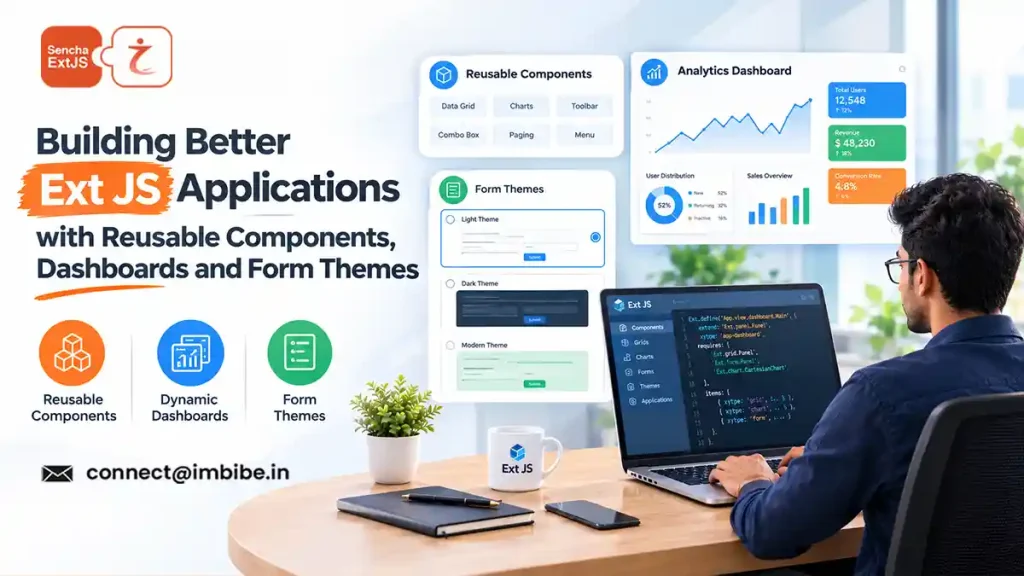
This is why reusable components, dashboard themes and form themes have become valuable considerations when developing Ext JS applications.
Why Reusability Matters in Ext JS
Think about a typical business application. It may have a customer management section, an inventory module, reporting screens, employee records and an administration panel. Although these areas serve different purposes, many of their interface requirements are surprisingly similar.
Users may encounter the same search field, date picker, data grid, confirmation window or action button across several screens. Creating each of these elements independently might seem manageable when a project is small. As the application expands, however, duplicated components can become difficult to maintain.
A change that should be simple can suddenly require modifications in several places. Even worse, those modifications may not always be implemented consistently.
This is where an ext js reusable components pack can be useful. The idea is straightforward: frequently required interface elements can be developed as reusable building blocks rather than recreated whenever a new screen is introduced.
Reusability can also improve the development experience. Once developers understand how a shared component works, they can use it with greater confidence across different parts of an application. New screens can be developed faster because the team is working with familiar building blocks rather than solving the same interface problem repeatedly.
There is, however, an important distinction between reusable and overly generic components. A component should be reusable because it represents a genuine recurring requirement. Trying to make one component handle every possible scenario can make the code harder to understand and maintain.
The goal should be sensible reuse, not reuse for its own sake.
Turning Data Into Something Users Can Understand
Enterprise applications often contain enormous amounts of data. A user might need to review hundreds or thousands of records while simultaneously understanding the broader picture behind those records.
This is where dashboards become valuable.
A data grid can provide detailed information, while charts can help users recognise patterns and trends more quickly. When these elements are thoughtfully combined, users can move from an overview to the underlying details without having to navigate through multiple unrelated screens.
An ext js grid and chart dashboard theme can provide a structured foundation for this type of interface. Instead of designing every dashboard from the ground up, developers can work with established visual patterns for presenting grids, charts, filters and supporting information.
The important thing, though, is not simply placing a chart beside a grid.
Good dashboard design begins with understanding what the user needs to know. A financial dashboard, for instance, may prioritise revenue trends and transaction details. An operations dashboard may focus on workload, turnaround times and exceptions. A sales dashboard might place greater emphasis on pipeline movement and conversion.
The components may be similar, but the way they are arranged and presented should reflect the user’s actual workflow.
A dashboard should answer questions, not simply display data.
Forms Are Part of the User Experience
Forms are often overlooked because they are such a familiar part of business software. Yet for many applications, forms are where users spend a significant portion of their time.
Whether someone is adding a customer, creating an order, registering an employee or updating a record, the quality of the form directly affects how easily the task can be completed.
A cluttered form can make even a simple process frustrating. Inconsistent field sizes, unclear validation messages, poorly positioned buttons and confusing visual hierarchy can force users to spend more time understanding the interface than completing the task.
An Ext JS form components theme can help establish a consistent visual language across different types of form controls. Text fields, dropdowns, date selectors, checkboxes, radio buttons and action buttons can follow the same design principles throughout the application.
Consistency matters because users learn interfaces through repetition. If a required field is identified in one way on one screen and differently somewhere else, the user has to interpret the interface again. When common patterns remain consistent, interaction becomes more intuitive.
A good form theme should therefore support usability rather than simply make a form look attractive.
Consistency Across the Application
A professional application should feel consistent even when different teams have worked on different sections of it.
That consistency goes beyond colours and typography. It includes spacing, component behaviour, validation, button placement, interaction states and the way information is organised.
Reusable components and themes can help establish those standards.
For example, if a particular type of action button behaves and looks the same throughout an application, users quickly understand what to expect. If grids use familiar filtering and sorting patterns across different modules, users do not need to relearn those interactions each time they switch screens.
This becomes particularly important in enterprise software because users may spend several hours a day working within the same application.
The interface should become familiar rather than becoming another obstacle in their workflow.
Reusability and Long-Term Maintenance
The value of reusable components becomes even clearer as an application matures.
During the early stages of development, creating a component specifically for one screen may seem faster. But once an application has dozens of screens, maintaining multiple versions of similar components can become expensive.
A shared component can reduce that duplication. If the underlying behaviour needs to change, developers have a central implementation to work with rather than a collection of almost-identical components.
This can also help maintain visual consistency as the application evolves.
However, reusable components need proper documentation and sensible organisation. Developers should know what a component is designed to do, what configurations it supports and where it is appropriate to use it.
Without that discipline, a component library can become just as difficult to manage as duplicated code.
Performance Should Not Be an Afterthought
Enterprise applications also need to remain responsive as their data and functionality increase.
A dashboard containing several charts and grids, for example, may place considerably more demands on the browser than a simple form. Components need to be designed with rendering, data loading, event handling and updates in mind.
The same principle applies to reusable components. A component that performs well in isolation should also behave efficiently when it is used repeatedly across a larger application.
Performance should therefore be considered during component design rather than treated as a problem to solve later.
Building Interfaces That Can Grow
The best Ext JS applications are not necessarily the ones with the most components. They are the ones where those components have been thoughtfully designed around real user requirements.
Reusable components can reduce development repetition. Dashboard themes can create better ways of working with data. Form themes can make everyday interactions more consistent. Together, these approaches can provide a foundation that allows an application to grow without its interface becoming increasingly fragmented.
The objective is not to make every screen identical. Different parts of an application will naturally have different requirements. The objective is to establish enough consistency that users always feel they are working within the same system.
Where ExtNuke Fits In
For developers who want to accelerate this process, ExtNuke brings together Ext JS resources designed around practical application development. Instead of treating every component or interface requirement as a completely new task, developers can explore ready-made resources that can help reduce development effort while maintaining a professional and consistent UI.
The value of such resources is particularly apparent when a project requires multiple screens, data-heavy dashboards or forms with a consistent visual treatment. Having a starting point can allow developers to spend more time refining application logic and user workflows instead of repeatedly recreating common interface elements.
For teams working extensively with Ext JS, the right component resources can become a useful part of the development toolkit.
Conclusion
A scalable Ext JS application needs more than functional code. It needs an interface architecture that can evolve alongside the application.
Reusable components do away with needless duplication. A well-organized dashboard makes it easier for users to grasp complicated information. Consistent form components make everyday workflows easier. When these elements are designed with usability, maintainability and performance in mind, they can make a significant difference to the quality of an enterprise application.
The bigger lesson here is that developers don’t need to reinvent the wheel for every single interface element on every single project. Starting with thoughtful, reusable building blocks can make development faster while creating a more consistent experience for the people who ultimately use the application.
If you are building Ext JS applications and want to spend less time rebuilding common UI elements and more time building meaningful functionality, explore ExtNuke’s collection of Ext JS components, themes and development resources today. Find resources for your project, speed up your UI development and build a more sophisticated Ext JS application, no need to start from scratch.